
Whose Classics Count?
H.R. 7661, the Distraction Machine, and the Children We’re Actually Failing

Infophilia, a Positive Psychology of Information | March 2, 2026 | Vol. 4, Issue 14 | Bonus edition | Updated March 5 & March 4, 2026 - ALA link to Support Federal Library Fundingfor FY 2027 & Addendum Added.
Artificial Intelligence | Information Styles | Intellectual Freedom | Toolbox | Wellbeing
✨ Welcome to Infophilia, a weekly serial exploring how our love of information and connection can help us thrive, individually and collectively.
Today’s essay, a bonus, complements both our NLLD 2026 journey and the FTC 6(b) series. It is published open access in honor of Dad, a lover of classical Tamil and world literature.
📌Access & Attribution: This serial offers free previews always and occasional open access essays to keep scholarship accessible. Students and those facing financial barriers can request complimentary access. If you find value here, please cite the original work and consider supporting the public scholarship through subscription. Proper attribution sustains this work and models healthy information engagement.
Cite as: Coleman, A. S. (2026, March 2). Whose classics count? H.R. 7661, the distraction machine, and the children we’re actually failing. Infophilia, a positive psychology of information, 4(14).
Whose Classics Count?
H.R. 7661, the Distraction Machine, and the Children We’re Actually Failing
A Confession
The civic muscle worth flexing is not always the most obvious one.
Last week, we encouraged readers to contact their Representatives opposing H.R. 7661. Then I sat down to write my own letter. What I discovered changed the letter.
Our Representative is a freshman on Capitol Hill, a steadfast supporter of libraries, and a trained economist and lawyer who understands the Federal Trade Commission’s investigative framework. The economist measures infrastructure returns. The lawyer reads investigative findings and knows how enforcement works. That combination makes him unusually suited to champion libraries not as cultural ornaments but as the trusted public infrastructure through which children should safely encounter knowledge.
A generic opposition letter felt hollow. A letter connecting H.R. 7661 to recent FTC 6(b) investigations, to the fragile infrastructure of public and school libraries, and to the information literacy needs of children in his district felt right.
This essay documents the research behind that letter: a constitutional, cultural, and technological critique of performative legislation, with three contributions at its core: the distraction machine, the canon critique, and the multimodal literacy/AI pivot.
Fire Horse
It is the Year of the Fire Horse, a year that arrives, according to the Chinese zodiac, only once every sixty years, carrying with it associations of dynamism, boldness, and forward motion that cannot be contained.
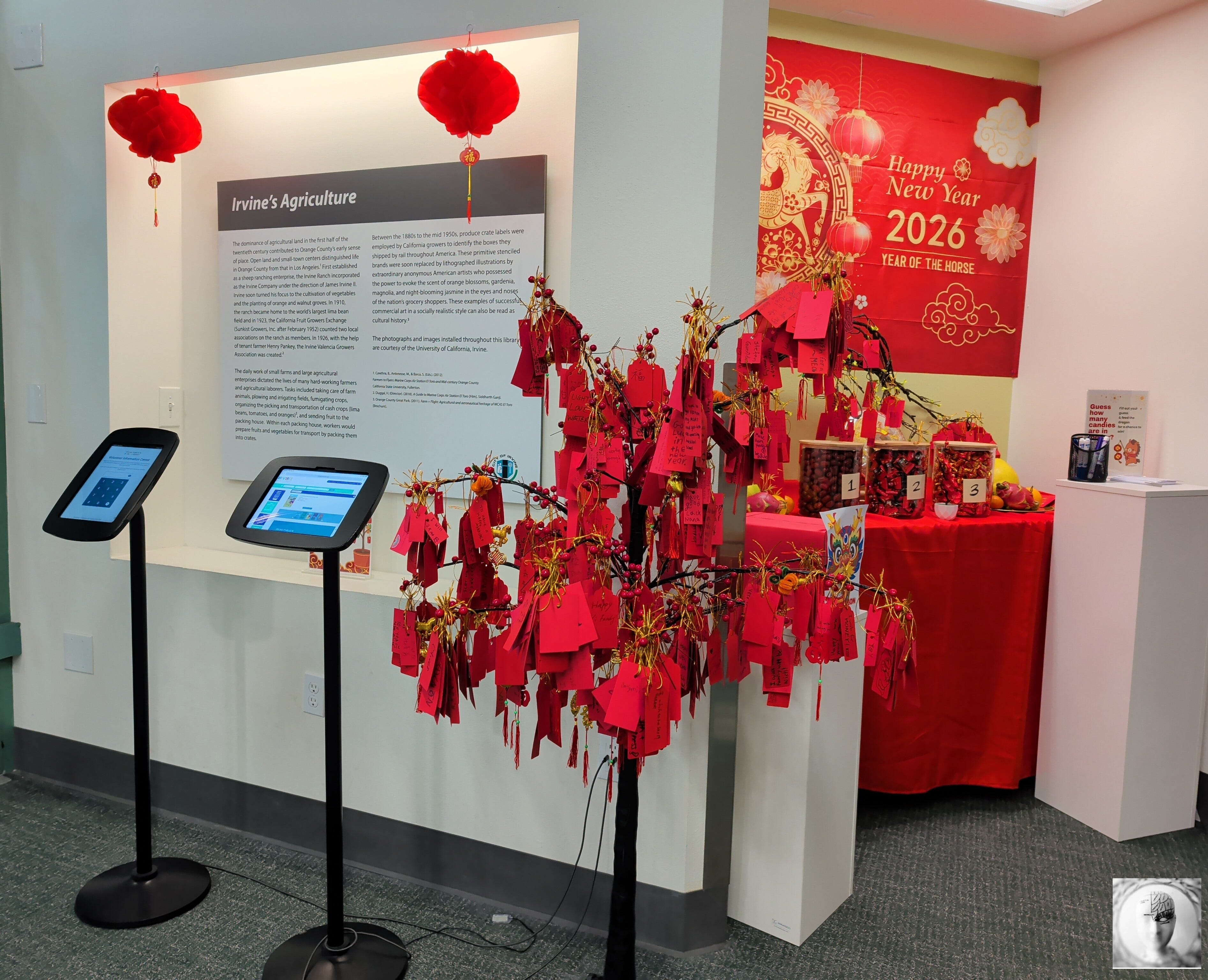
In our local library, like others across the country, Lunar New Year celebration events and displays are now underway. Red lanterns honor the poets and storytellers of cultures that have been telling stories for millennia — dynasties of literature that existed long before the printing press in Europe, long before Shakespeare in England, long before the University of Chicago decided what counted as a “Great Book.”
Walk past those displays and into the stacks. Pull down Rabindranath Tagore’s Gitanjali — 103 lyric poems he translated from Bengali into English on his sickbed. W.B. Yeats read the manuscript and declared he had found someone greater than any of them. Ezra Pound agreed. In 1913, Tagore became the first Asian and first non-European to win the Nobel Prize in Literature. The Swedish Academy awarded Tagore its prize for verse of “profoundly sensitive, fresh and beautiful” quality, written in “his own English words.”
Here’s a favorite — a prayer to intellectual freedom — that one in 7 people in the world are likely to have memorized.
Where the mind is without fear and the head is held high;
Where knowledge is free;
Where the world has not been broken up into fragments by narrow domestic walls;
Where words come out from the depth of truth;
Where tireless striving stretches its arms towards perfection;
Where the clear stream of reason has not lost its way into the dreary desert sand of dead habit;
Where the mind is led forward by thee into ever-widening thought and action —
Into that heaven of freedom, my Father, let my country awake.
— Rabindranath Tagore, Gitanjali, Poem 35
Now download a copy of H.R. 7661, the Stop the Sexualization of Children Act, introduced in the United States House of Representatives on February 24, 2026. The bill would prohibit federal education funding for materials its authors deem sexually oriented. It defines “classic works of literature” worthy of protection by three specific lists: the 1990 Great Books of the Western World and two Compass Classroom articles.
Tagore is not on any of them.
The Distraction Machine
H.R. 7661 is a distraction machine.
The distraction machine doesn’t just fool infofools. It captures infophiles too.
The bill arrived the same day as the longest State of the Union in American history. That address invoked “radical indoctrination” in schools, celebrating “a tremendous renewal in religion, faith, Christianity,” and promoting a Presidential AI Challenge for students framed as keeping America’s next generation “positioned to succeed.”
The timing is not accidental. Performative legislation rarely is.
H.R. 7661 has no Senate companion. It was referred to committee and will almost certainly go nowhere. Its function is not legislative success. Its function is to capture attention.
Meanwhile, AI chatbots hum in children’s bedrooms and on their smartphones, engineering parasocial companionship while failing teenagers in crisis. Recent court testimony in New Mexico revealed Meta’s own internal tests: child sexual exploitation safeguards failed 66.8% of the time; violent content 63.6%; suicide/self-harm prompts 54.8%.***
Seven major technology companies remain under federal scrutiny.
Every letter written to a Representative about H.R. 7661 is a letter not written about AI companion platforms that are documented to be failing children in suicidal crisis. Every hour spent organizing opposition to a bill that will never pass is an hour not spent demanding the FTC investigations into information technology companies produce enforceable policy. Every press release about book banning is a press release not issued about the absence of federal AI safety standards for educational platforms.
Brave New World has quietly colonized our consciousness.
The horse the bill is trying to control is in the library.
The horse that needs restraining is on every child’s phone.
Still.
Performative legislation deserves analysis, because what a political coalition chooses to perform and what the opposition chooses to oppose reveal values. They tell us what they actually believe. Whose children matter? Whose literature counts? Whose ways of knowing deserve federal protection? That is worth examining.
Whose Canon, Whose Law
One of the bill’s approved sources, Compass Classroom, is a Christian homeschooling curriculum whose stated mission is advancing the Kingdom of God.
A list written in devotion is being written into federal education law. What begins as a debate about taste becomes a constitutional question. A canon assembled to guide private religious education is being elevated into the machinery of federal funding for public schools.
But the instinct to gather words into constellations is ancient, and it’s never singular.
Tamil poets were writing about love, longing, and the monsoon two thousand years ago while Rome was still a republic, producing one of the oldest continuous literary traditions in human history. The Sangam anthologies endured because generations argued over them, memorized them, recited them into being. No state enshrined them.
In Persia, divans gathered centuries of verse into luminous archives of longing and metaphysics.
In West Africa, griots carried genealogies, law, and epic across generations without ink or parchment, holding entire civilizations in the cadence of the human voice.
What is to be done, O Moslems?
…
I have put duality away, I have seen that the two worlds are one;
One I seek, One I know, One I see, One I call.
- Rumi
These were canons too. But they were currents, not cages.
They survived because they were lived.
Here’s what the bill cannot see:
The 1990 Great Books list, frozen in time, reflects a particular Western intellectual lineage — assembled in mid-20th century America, by one culture's account of what counted as great. Homer, Dante, Shakespeare, Freud, William James. Extraordinary writers. Not Tagore. Not Murasaki Shikibu, whose Tale of Genji predates the European novel by centuries. Not Rumi, whose poetry traverses eight hundred years and who is the top seller of poetry in America. Not the Harlem Renaissance, Langston Hughes, Zora Neale Hurston, W.E.B. Du Bois, whose literature fused jazz and prose into a distinctly American inheritance.
Not Gabriel García Márquez, whose One Hundred Years of Solitude is among the most celebrated novels of the 20th century, winner of the Nobel Prize in Literature. The US government denied García Márquez a visa to enter our country until the 1990s, long after American students were reading his books in classrooms. The bill continues that tradition by a different mechanism: not a visa denial, but a definition. One Hundred Years is welcome in American classrooms. It simply won’t be recognized as worthy of federal protection.
Gloria Anzaldúa, whose Borderlands/La Frontera gave American literature its most precise language for living between cultures is absent. The Latino community that is California's largest demographic group, whose writers have been documenting the American experience from the inside for generations (Allende, Cisneros, many more), would find their entire literary tradition unprotected under this bill.
Not a single indigenous voice from anywhere in the world. Not a single woman writer before the 20th century — only those who wrote anonymously or under male names, because the canon had no room for them otherwise.
By codifying three lists into federal funding law, H.R. 7661 does more than define classics. It privileges a worldview.
The canon becomes not a conversation but a statute.
And by privileging Compass Classroom's Christian worldview, it drifts towards the boundary the Establishment Clause was designed to protect, erecting one faith's bookshelf where the First Amendment demands none.
The bill is not afraid of these books because they are sexual. It is afraid of them because they carry answers; and those answers challenge the claim that one civilization's conversation is the only conversation worth having.
The Multimodal Turn
Literacy is not only printed text. The Harlem Renaissance understood, a century before the term existed, that knowing takes many forms.
“Jazz, to me, is one of the inherent expressions of Negro life in America: the eternal tom-tom beating in the Negro soul — the tom-tom of revolt against weariness in a white world, a world of subway trains, and work, work, work; the tom-tom of joy and laughter, and pain swallowed in a smile.” — Langston Hughes
The drum carried knowledge across the Atlantic in enslaved bodies. Spirituals encoded escape routes and theology. Jazz improvised memory in Harlem, fusing African rhythm with European harmony into something entirely new.
Knowledge travels through voice, image, rhythm, ritual, performance. And now through algorithm.
Children do not encounter “books” in isolation. They encounter literature inside platforms, recommendation engines, companion bots trained to simulate empathy. And inside library databases including apps like Libby, where AI curation and data collection are quietly reshaping what children find, while most librarians are still catching up.
A funding policy built around a 1990 book list cannot address the conditions of 2026. The task is not freezing another canon but regulating the platforms through which knowledge now flows.
The distraction machine works precisely because it flatters our nostalgia. It invites us to argue about books while the architecture of attention is redesigned in code.
The values at stake here are not only about literature. They are epistemological.
What counts as knowledge?
Who curates it?
Who funds it?
Who profits from its distribution?
The distraction machine doesn’t just fool infofools. It captures infophiles too.
What We Are Actually Failing
In California, there is roughly one credentialed school librarian for every 9,000 students. One-third of K–12 students have never met a teacher-librarian. Nearly half of schools cannot accurately report their collections because no librarian exists to curate them.
At the same time, AI companions are being marketed as tutors, friends, confidants.
The civic muscle worth flexing is not always the most obvious one.
Opposing H.R. 7661 may feel righteous. But the deeper work of funding librarians, enforcing FTC findings, and establishing AI safety standards, lacks spectacle. It lacks viral outrage. It lacks culture-war heat.
A River, A Confluence, Not A Cage
A canon worthy of American children in 2026 would include Homer and Shakespeare, Tagore and Murasaki Shikibu, because they’re all extraordinary. It would include Rumi, Hughes, Hurston, Morrison, Marquez, Allende, Cisneros. They’re extraordinary.
The Tamil Sangam poets knew something about endurance. They wrote of landscape and longing while empires rose and fell. Persian poets gathered centuries into a single volume of verse. Griots held law and lineage in memory alone.
None required Congress to declare them classics
A canon is a river with many tributaries.
The river becomes something else when the state freezes it into statute and calls the water still.
The Western canon is often described as if it were a mountain spring: pure, self-originating, rising from European soil untouched by elsewhere.
History tells a different story.
Aristotle survived not because Europe preserved him, but because scholars in Baghdad translated and commented on him for centuries. The numerals that made European mathematics possible traveled from India through the Islamic world before Fibonacci introduced them to Italy. Shakespeare borrowed plots that had already passed through Persian and Italian hands.
Ideas moved the way cotton, spices, and tea moved: along trade routes, across languages, through conquest and pilgrimage and exile.
Tagore read Whitman. Hughes read Tagore. García Márquez read Faulkner and said he couldn’t have written without him. Faulkner read the Bible, which traveled through Hebrew, Greek, Latin, Arabic, and English before it reached Mississippi, carrying the accumulated wisdom of civilizations the bill’s approved lists would not recognize. None of them were reading from an approved list. They were reading everything.
The great conversation was never contained in sixty volumes. It was always happening across languages, across oceans, across the boundaries that lists try to draw.
There’s no Western canon. There never was. There’s only a confluence.
What H.R. 7661 seeks to freeze into statute is not humanity’s timeless inheritance. It is a snapshot taken mid-current at a nonexistent source and declared the origin.
The Letter
I am still drafting the letter to our Representative. I am writing to the economist who measures infrastructure returns and the lawyer who knows how enforcement works. I will not be urging him to issue a press release condemning H.R. 7661. Instead I’ll urge him to press the FTC for timelines. To translate investigative findings into enforceable AI safety policy. To fund libraries and librarians as infrastructure.
Because the horse the bill is trying to control is in the library.
The horse that needs restraining is on every child’s phone.
The Year of the Fire Horse comes once every sixty years. It symbolizes energy that cannot be contained. So does knowledge. So does childhood.
About the Images
Regular readers know I use my own photos to make the points words alone cannot.
Fire Horse display at the library entrance commemorates a Lunar New Year celebration. The living literary traditions the bill’s approved lists cannot see.
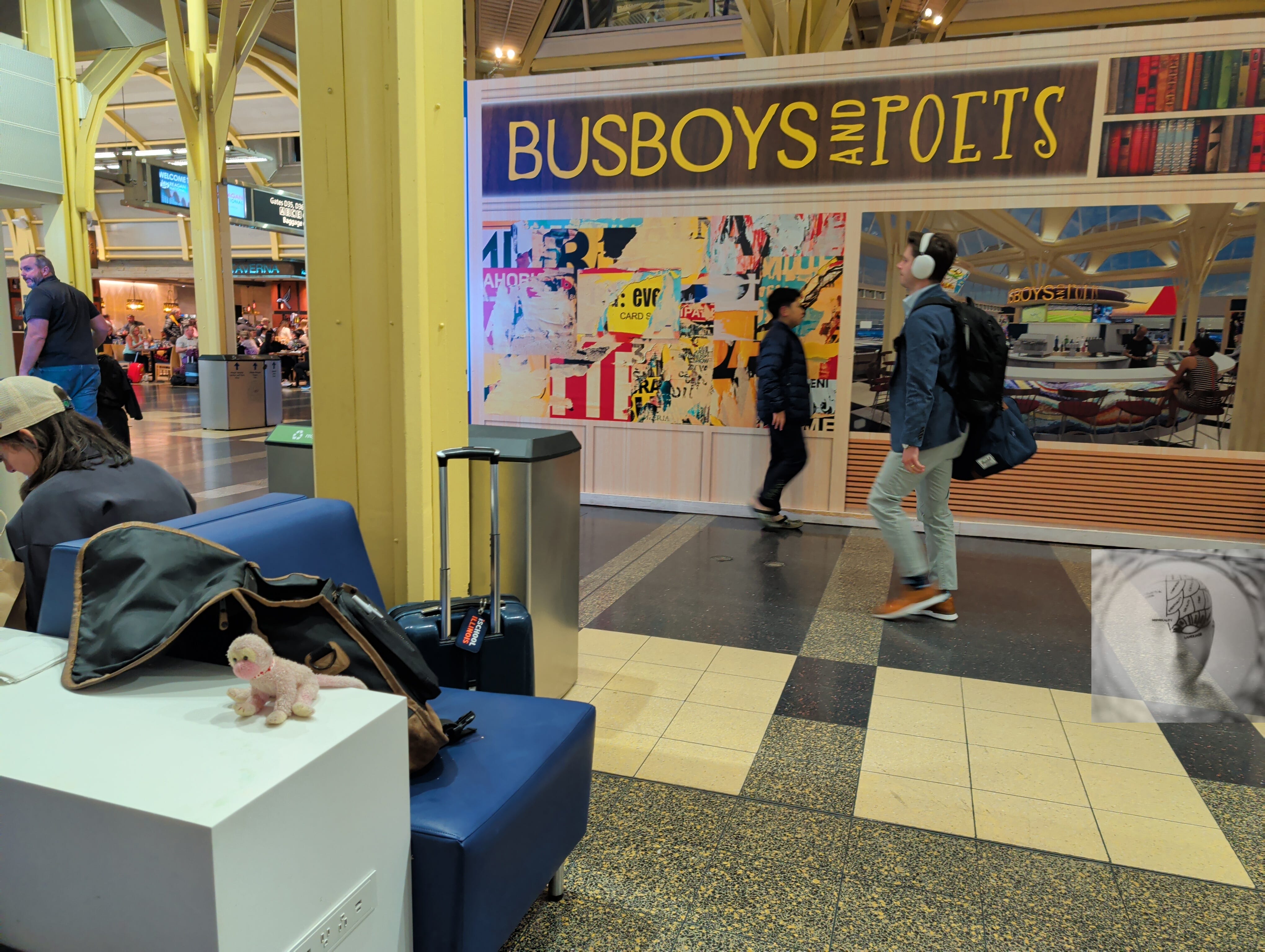
Busboys & Poets, named for Langston Hughes, who worked as a busboy before his poetry was discovered, is a Washington D.C. institution combining restaurant, bookstore, and space for readings, talks, and civic engagement. This location is in the airport, where America passes through. Photographed just as we landed and the State of the Union began; H.R. 7661 was introduced that same day, February 24, 2026. Hughes is not on the bill’s approved lists. The culture the bill fears. The evidence: living, multiracial, multimodal, multiliterary. Everything the bill seeks to erase, already flowing richly.
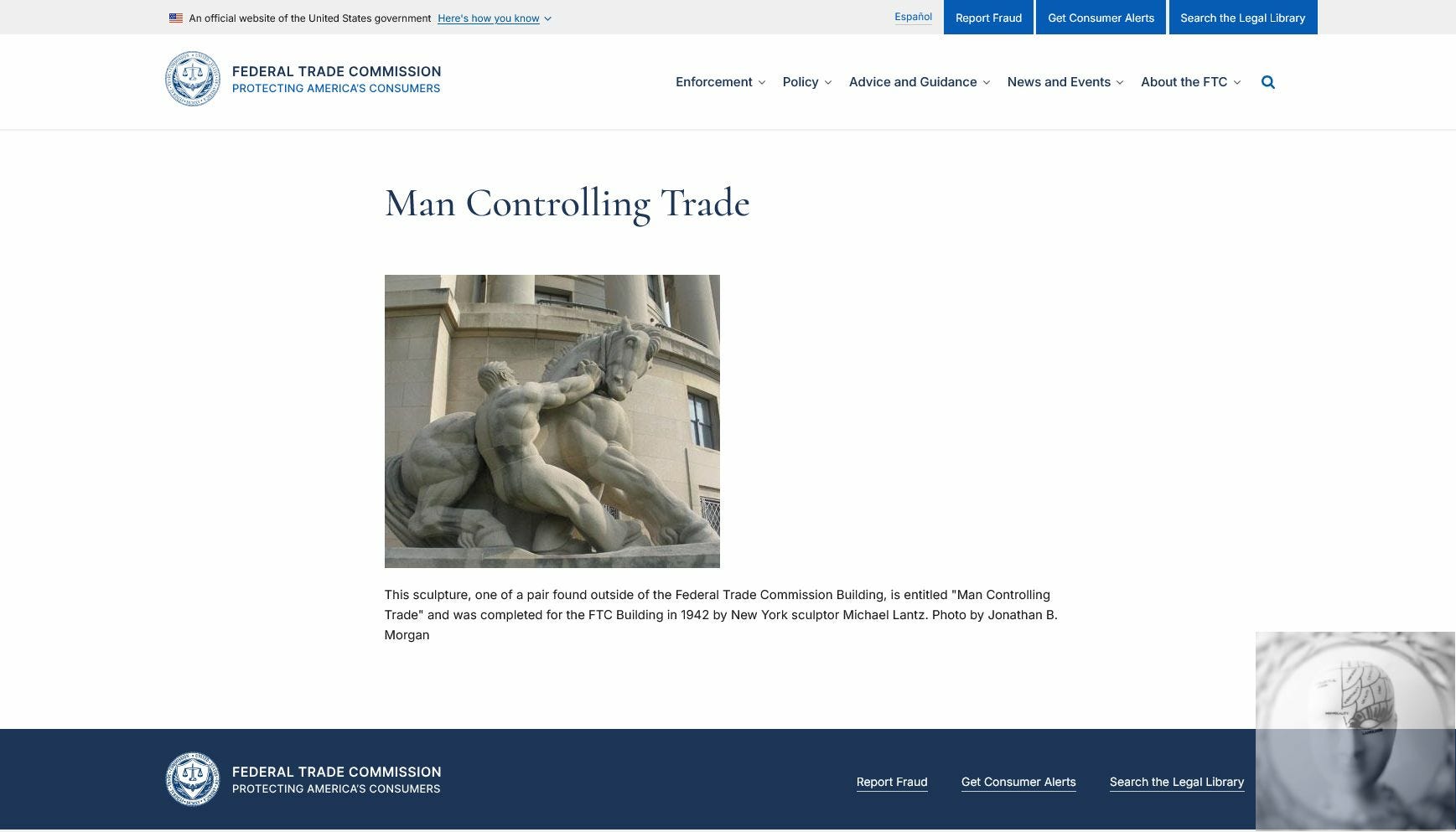
Outside the Federal Trade Commission building in D.C. stand a pair of monumental equestrian sculptures: “Man Controlling Trade,” created by Michael Lantz. The regulatory body that should act, rendered in limestone, straining against a horse symbolizing trade. The horse that needs restraining is on every child’s phone.
Acknowledgments
Andre Mouchard (Orange County Register), Renee Ousley-Swank (CDE), and Jeff Camp (Ed100). Many other professionals also responded helpfully and promptly in response to my request for CA & OC local data when I was preparing for NLLD in February. They aren’t named here to preserve their privacy. Any mistakes in the data are mine.
Notes
The essay connects to adaptive infophilia, our evolutionary drive for information and connection, which exists on a spectrum from healthy infophiles who seek diverse knowledge across cultures and modalities, to disordered infofools captured by algorithmic silos and culture war noise. The distraction machine works precisely because it exploits that spectrum: it gives infofools a fight to have while infophiles spend their energy on the wrong threat.
Adaptive infophilia reframes information literacy from threat detection to human flourishing. Not SIFT. Not CRAAP. Not checklists. A cultivated love of knowing that seeks diverse sources across cultures, modalities, and centuries. What Tagore was doing on his sickbed. What Hughes was doing reading Tagore. What Dad was doing with classical Tamil literature, world literature. What this essay is trying to model.
Libraries stand as society’s ultimate expression of intellectual freedom, a mission that the American Library Association embodies daily. Their call to oppose H.R. 7661 comes from that noble place. But the distraction machine captures even our most trusted institutions. While we organize against a bill that will almost certainly never pass, AI companions are documented to be failing children in suicidal crisis, and federal AI safety standards remain absent. Let’s honor ALA’s urgency by demanding enforceable FTC policy from their 6(b) findings — equipping librarians with digital literacy curricula to fight the battles that actually matter.
H.R. 7661, Stop the Sexualization of Children Act, 119th Congress. https://www.congress.gov/bill/119th-congress/house-bill/7661/text | Great Books of the Western World (1990 Encyclopedia Britannica ed). see https://en.wikipedia.org/wiki/Great_Books_of_the_Western_World | Purifoy, T. Jr. “Classics Every Middle Schooler Should Read.” Compass Classroom. https://compassclassroom.com/blog/classics-every-middle-schooler-read/ | Purifoy, M. P. “Classics Every High Schooler Should Read.” Compass Classroom. https://compassclassroom.com/blog/classics-every-high-schooler-should-read/
California Department of Education school library data, 2024–25. www.cde.ca.gov/ci/cr/lb/schoollibrstats08.asp
Garrison, D. (1979). Apostles of Culture: The Public Librarian and American Society, 1876–1920. The foundational account of how public libraries formed their professional identity — and whose culture they were apostles of. | Buchel, O., & Coleman, A. S. (2022). A statistical essay on diversity in the library professions compared to other occupations in the United States. Library Trends, 71(2), 303–337. https://doi.org/10.1353/lib.2022.a922380
***In February 2026 testimony in New Mexico's lawsuit against Meta, NYU professor Damon McCoy described internal red-teaming results for a Meta chatbot product. A June 6, 2025 report showed failure rates of 66.8% for child sexual exploitation, 63.6% for violent content including sex-related crimes and hate, and 54.8% for suicide and self-harm prompts. Meta argues these figures come from stress tests that don't reflect typical user experience. McCoy testified that, given the severity of the conversations, this was not something he would want anyone under 18 exposed to. https://www.axios.com/2026/02/16/meta-ai-chatbots-kids | https://finance.yahoo.com/news/meta-shares-truth-troubled-ai-133053549.html?
On school librarian ratios: SLIDE: The School Librarian Investigation — Divergence & Evolution. San José State University School of Information / IMLS. https://libslide.org | https://ed100.org/
On the FTC investigation into social media and AI companion chatbots — see recent essays: https://infophilia.substack.com/p/ftc-6b-orders-venezuelas-information | https://infophilia.substack.com/p/the-ftcs-secret-weapon-for-informationa
While ALA/PEN statements broadly address censorship, they primarily highlight LGBTQ+ book bans instead of global literature. https://www.publishersweekly.com/pw/by-topic/industry-news/libraries/article/99810-same-ingredients-different-recipe-in-proposed-u-s-book-ban.html
At NLLD, besides LSTA, IAL, E-rate funding, we also sought support for the Right to Read Act. Yet, the question of platform power, AI governance, and whose literature receives federal protection remains largely unaddressed — by the bill and its opposition alike. More about each funding request is embedded below.

ALA / Show Up For Libraries: Federal Library Funding for FY 2027 - March 5, 2026
A brief timeline worth noting: On February 27, as delegates were still sending thank-you notes from the Hill meetings, we received an email urging us to oppose H.R. 7661. Then, on March 3, 2026, Show Up for Libraries sent a separate email asking advocates to support federal library funding for FY2027. We’re now learning that the House appropriations process is on an accelerated schedule this year.
These are related but distinct asks. Congressional offices receiving multiple constituent communications in the same week may prioritize neither. The funding ask is the more consequential of the two — it has a deadline, measurable dollar amounts, and direct impact on library infrastructure. The appropriations deadline is March 20. If you can only write once before March 20, write about funding.
Send an email to your representative using this form: https://app.oneclickpolitics.com/campaign-page?cid=08ititJgTZazO3ulD4m1p&lang=en
Addendum - March 4, 2026
The House Education & Workforce Committee, to which H.R. 7661 has been referred, has been simultaneously conducting a hearing series titled “Building an AI-Ready America.”
The January 14, 2026 inaugural hearing brought witnesses from OpenAI, MagicSchool AI, and the Center for Democracy & Technology to testify on AI’s impact on workforce, job training, and education. The committee has already held four hearings; today’s fifth, March 4, 2026, can be watched live on the Committee website https://edworkforce.house.gov/
The February 24 hearing — "Teaching in the AI Age" — was held the same day H.R. 7661 was introduced. The same committee. The same afternoon. One agenda item examined AI's impact on children's education. The other defined approved book lists.
The distraction machine operates in plain sight.
The Center for Democracy & Technology’s testimony at the January 14th hearing is particularly relevant here. Their polling found that the more AI is used in school, the more likely students were to engage generative AI for companionship, mental health support, romantic relationships, and escape from real life — precisely the parasocial dynamic the FTC investigations are examining. All six CDT takeaways are worth reading: https://cdt.org/insights/six-takeaways-from-education-and-workforce-committee-hearing-on-building-an-ai-ready-america/.
The full hearing series is documented here: https://edworkforce.house.gov/calendar/list.aspx?EventTypeID=189.
YouTube streams for the Committee: https://www.youtube.com/@EdWorkforceCmte/streams
Like your river metaphor, deep and pulling, bracing and refreshing, essential sustenance. Thank you. This essay gives much to ponder and sustain.